An Edition Number Is Not an Identity
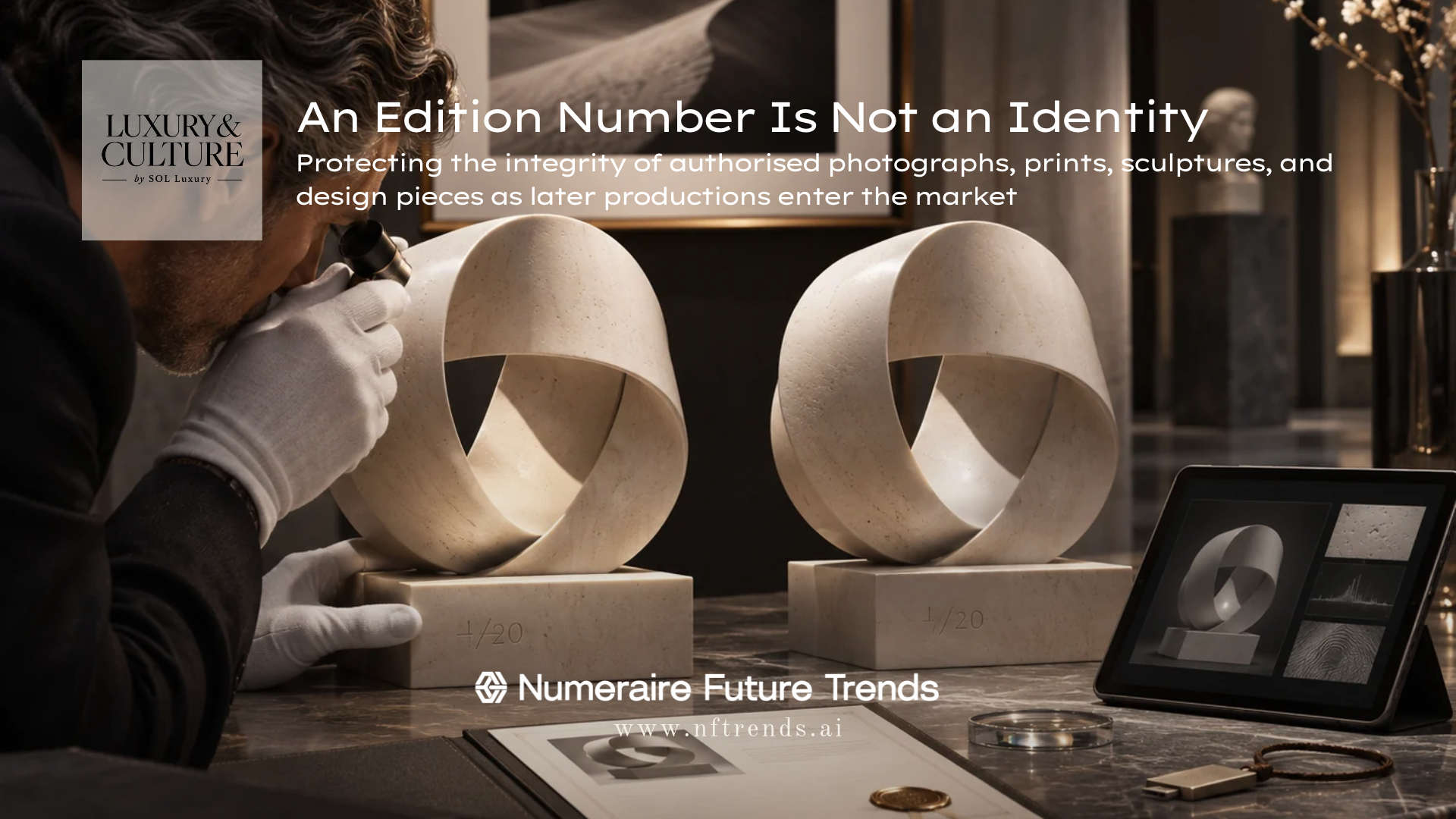
Protecting the integrity of authorised editions when reprints, recasts and reproductions enter the market
An artist authorises a photographic edition of twenty prints. Each carries a number, a signature and supporting documentation. Years later, another print appears bearing a number already assigned to an earlier work. Its appearance, materials and production quality seem consistent with the original edition. The accompanying certificate appears legitimate. Yet an essential question remains: which physical print belongs to the artist’s authorised edition?
This is a particular vulnerability in the market for limited-edition art and collectible design. Unlike a unique painting, a photograph, print, sculpture or design object may exist in several examples produced using the same original materials, processes or production masters. Establishing the authenticity of an edition is therefore only part of the challenge. Each individual piece must also remain reliably connected to the correct edition record, particularly as works enter the secondary market and later productions appear.
The Integrity of the Original Edition
Limited editions depend on a fundamental understanding between the creator and the collector. The artist establishes the authorised production, including its size, format and conditions. Collectors acquire individual works within that defined edition, with the expectation that their identity and relationship to the original production can be established.
However, the mechanisms used to produce limited editions also create a particular vulnerability.
Photographic negatives, digital masters, lithographic plates and sculpture moulds may remain available after an original edition is completed. Contemporary manufacturing technologies, including high-resolution scanning, CNC machining and 3D printing, have further expanded the possibilities for producing objects that closely resemble existing works.
Later productions are not necessarily illegitimate. An artist may authorise a new photographic edition, additional sculpture casts or the reissue of a design object. The concern arises when these later works cannot be reliably distinguished from pieces belonging to an earlier authorised edition.
For collectors, galleries and auction houses, this distinction has direct implications for attribution, provenance, scarcity and value. Two visually identical objects may have entirely different production histories and market significance.
The central issue is not whether additional editions should exist, but whether the integrity of each authorised production can be maintained.
Where Traditional Records Become Vulnerable
Edition numbers, signatures and certificates remain important elements of art-market documentation. They record an artist’s intentions, identify production details and provide evidence supporting the authenticity of a work.
Their limitation is that they do not necessarily establish a verifiable connection to one specific physical object.
Edition numbers can be reproduced, signatures forged and certificates copied or separated from their original works. Even authentic documentation can become associated with the wrong object.
The difficulty is particularly pronounced when several legitimate examples already share nearly identical appearances, materials and production characteristics.
As artworks move between galleries, collectors and auction houses, ownership histories may become fragmented. Decades later, the original artist, publisher or foundry may no longer be available to clarify conflicting records.
A certificate may accurately describe an authorised edition without conclusively identifying the physical piece presented alongside it.
This creates a distinction that has received increasing attention in discussions of physical-object authentication: establishing what an object is supposed to be is not necessarily the same as verifying which individual object it actually is.
Establishing Identity at Creation
For Abu Dhabi-based Numeraire Future Trends, the solution begins when an edition is created, while the artist can personally confirm its authorship, production details and the identity of each authorised piece.
The company’s approach combines two connected elements: a documented register of the authorised edition and a verifiable physical identity for every individual object within it.
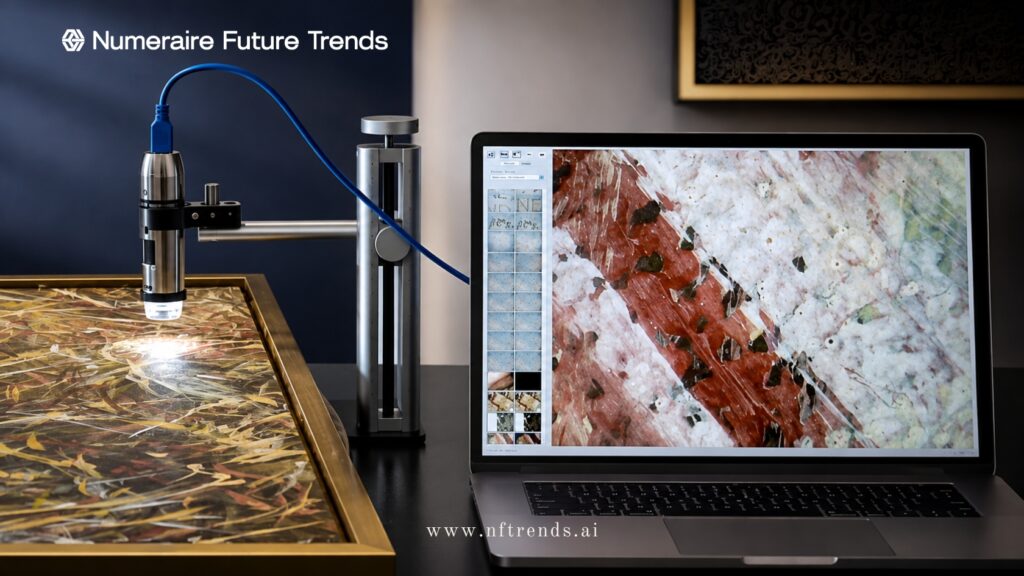
Rather than identifying a work through its image or visual composition alone, Numeraire’s technology examines intrinsic microscopic characteristics of its materials and surfaces. According to the company, variations in paper fibres, metal, resin and other materials can provide a distinctive physical signature, even when objects originate from the same mould, master or production process.
Numeraire uses these characteristics to establish what it describes as a biometric-level identity for each physical piece. That identity is then linked to firsthand, artist-confirmed documentation through a Digital Product Passport.
The distinction is significant. A digital certificate or electronic record can preserve information about an artwork, but its reliability depends partly on maintaining a trustworthy connection to the actual object.
Numeraire’s developed system is designed to make that connection physically verifiable, allowing a registered object to be checked against its recorded identity rather than relying exclusively on external markings or documents.
As Marsha Lipton, Co-Founder and CEO of Numeraire Future Trends, explains:
“For limited editions, the fundamental challenge is not identifying what the artwork represents or even which edition it belongs to. It is establishing exactly which physical piece we are dealing with.”
The technology does not replace the importance of artist authorisation or specialist expertise. Its intended contribution is to preserve the connection between a specific physical object and the documentation confirmed at the time of its creation.
When New Editions Enter the Market
The practical importance of this approach becomes clearer when reprints, recasts, reissues or reproductions appear.
Consider a sculpture originally authorised in an edition of eight. Years later, the artist approves a new series produced from the same mould. Both productions may be legitimate, and their physical appearance may be extremely similar. Nevertheless, they belong to different production records, potentially carrying different dates, edition sizes and market values.
If every piece in the original edition was individually registered and physically identified at creation, its identity could remain distinguishable from examples belonging to the later series.
Numeraire advocates recording subsequent authorised productions separately, with their own documentation, numbering and physical identities.
Such a system would help collectors and other market participants assess whether a particular object corresponds to the original authorised edition, a legitimate later production or an object that cannot be matched to the recognised records.
This is an important distinction in the company’s position. The objective is not to prevent artists from creating further editions or reproducing their work. It is to protect their ability to define what they have authorised and ensure that the market can identify those distinctions accurately.
Protecting the Artist’s Record
The strongest opportunity may exist with living artists, who can establish these records while their firsthand knowledge and authority remain available.
An artist can confirm the complete edition, document each individual piece, and establish its physical identity before it enters the market. This provides a stronger foundation for future verification, particularly when works change ownership or move across international markets.
The principle also extends to unique design objects, premium collectibles and memorabilia, where value may depend on a documented association with a particular creator, owner or historical event.
For Numeraire, establishing these connections at the outset is preferable to attempting to reconstruct them twenty or thirty years later, when crucial witnesses and original production information may no longer be accessible.
The implications extend beyond immediate transactions. Reliable identification can help protect an artist’s intentions, support responsible collecting and preserve the accuracy of an artistic legacy.
The increasing sophistication of reproduction technology makes the distinction between visual similarity and physical identity particularly relevant.
For the market in limited-edition photography, prints, sculpture and collectible design, protecting the integrity of an authorised edition requires a reliable record of both the production and the individual works within it.
The most important opportunity is at creation, when the artist can establish exactly what has been authorised and connect every physical piece to its original record.
That connection may ultimately prove as important to the long-term confidence of collectors as the edition number itself.